Additional information
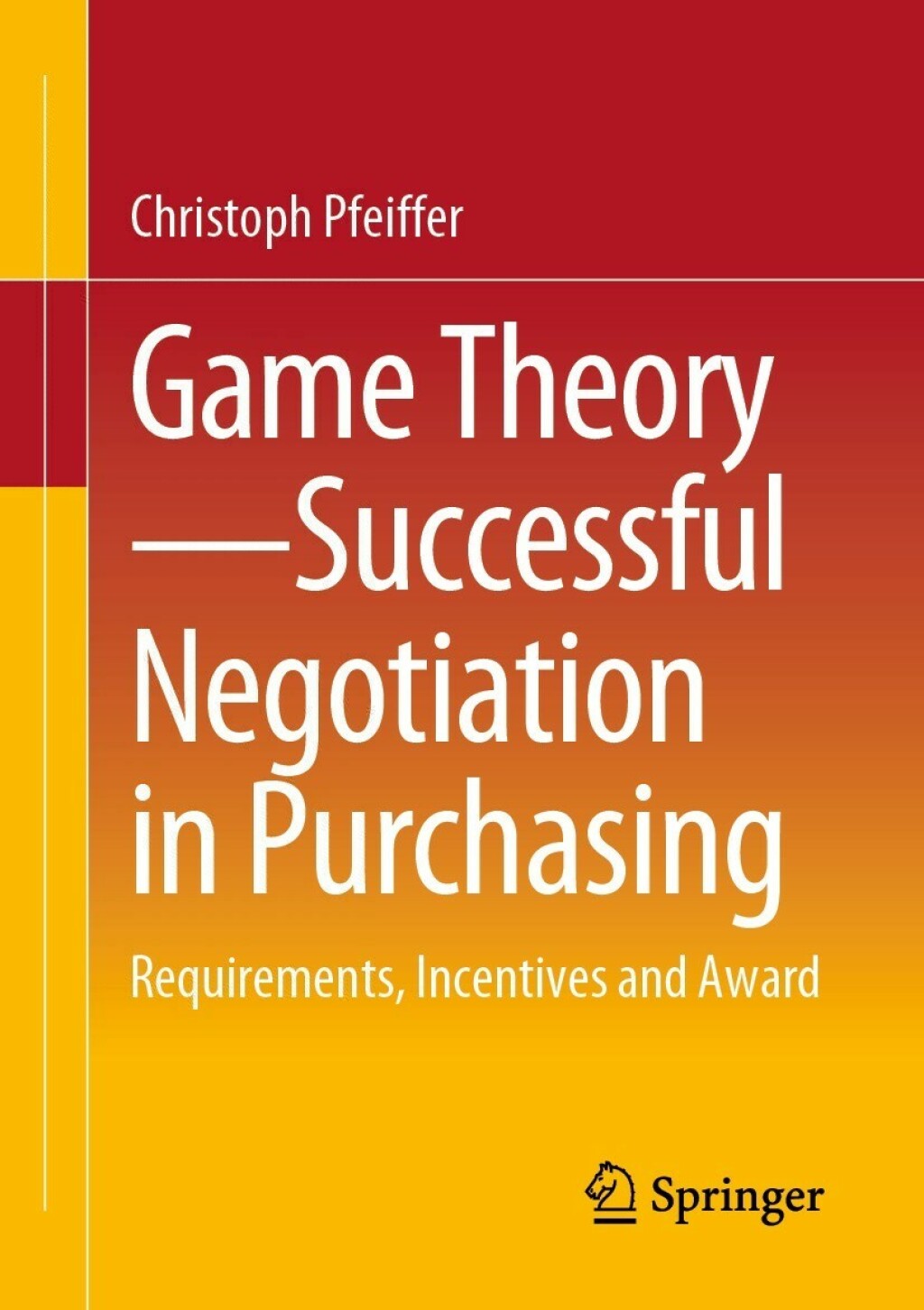
| Full Title | Game Theory – Successful Negotiation in Purchasing Requirements, Incentives and Award |
|---|---|
| Author(s) | Christoph Pfeiffer |
| Edition | |
| ISBN | 9783658408688, 9783658408671 |
| Publisher | Springer |
| Format | PDF and EPUB |

Original price was: $64.99.$24.99Current price is: $24.99.
Access Game Theory – Successful Negotiation in Purchasing Requirements, Incentives and Award Now. Discount up to 90%
Before checkout, confirm the ISBN, author, publisher, and edition match your course requirements. Secure payment and support are available at support@textbookfind.com.
| Full Title | Game Theory – Successful Negotiation in Purchasing Requirements, Incentives and Award |
|---|---|
| Author(s) | Christoph Pfeiffer |
| Edition | |
| ISBN | 9783658408688, 9783658408671 |
| Publisher | Springer |
| Format | PDF and EPUB |
Applied game theory in purchasing has become an important tool in many companies for systematically achieving success in negotiations. The central building block of game-theoretically optimized awards are purchasing auctions. A basic knowledge of auctions and game theory is therefore particularly important for purchasers. This book describes very clearly many helpful methods as well as their application in practice. Procurement situations which have a high volume, which are interesting for suppliers and whose performance can be well specified are particularly suitable for the use of game theory in purchasing. It also shows how cartels or restrained competition between suppliers can be identified using a purely data-based method. Every purchase involves a sale. The book is therefore not only aimed at buyers. Auctions in procurement and the underlying game-theoretical principles also play an equally significant role for sellers.Applied game theory in purchasing has become an important tool in many companies for systematically achieving success in negotiations. The central building block of game-theoretically optimized awards are purchasing auctions. A basic knowledge of auctions and game theory is therefore particularly important for purchasers. This book describes very clearly many helpful methods as well as their application in practice. Procurement situations which have a high volume, which are interesting for suppliers and whose performance can be well specified are particularly suitable for the use of game theory in purchasing. It also shows how cartels or restrained competition between suppliers can be identified using a purely data-based method. Every purchase involves a sale. The book is therefore not only aimed at buyers. Auctions in procurement and the underlying game-theoretic principles also play an equally significant role for sellers.